
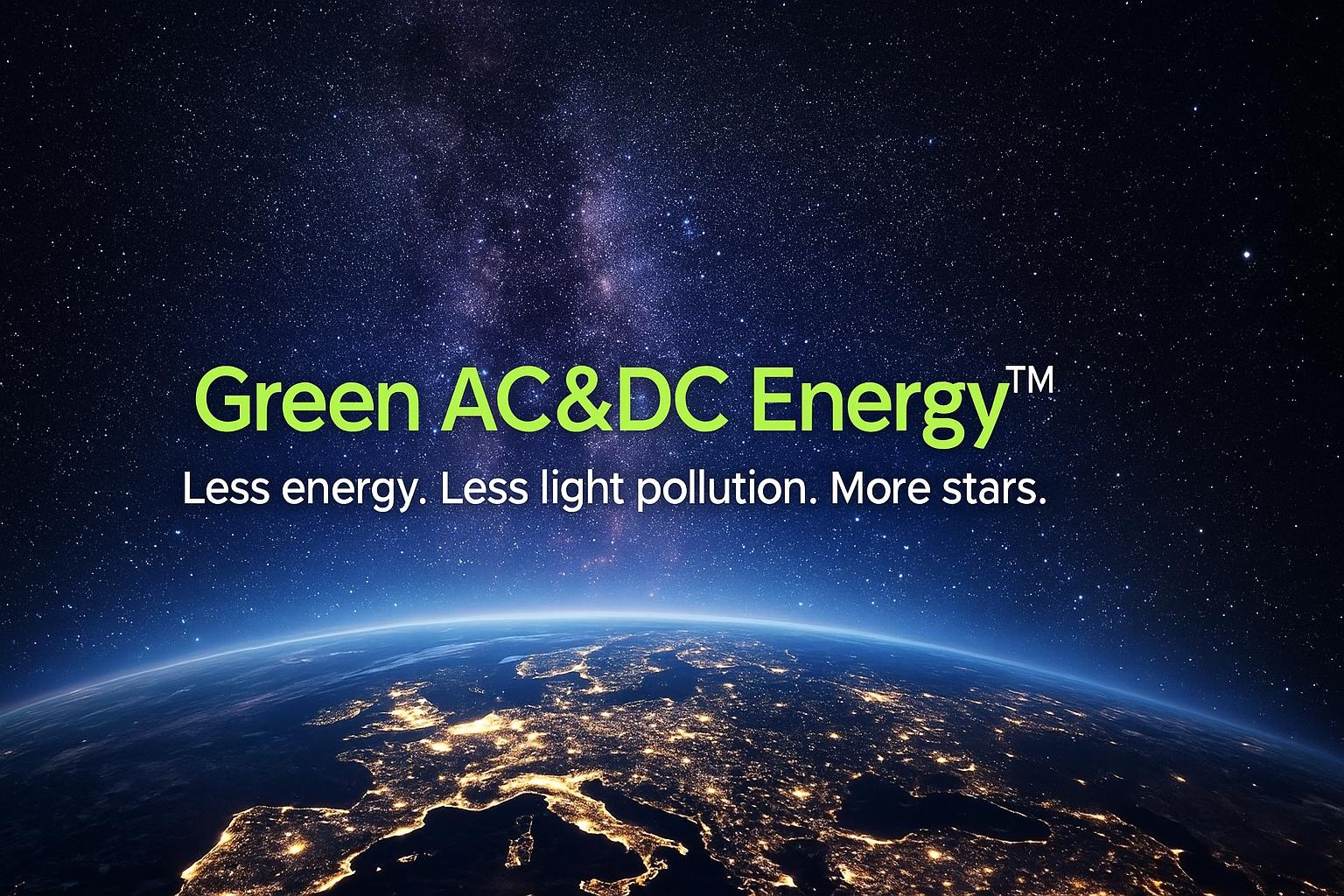
Green AC&DC Energy™ is not just a project to reduce electricity consumption. It is the personal author’s contribution of Lirim Muharemi to a calmer planet, healthier people, and a night sky where the stars can be seen again.
Green AC&DC Energy™ – energy, health and the sky above us
In recent years, there has been growing attention on light pollution and on how excessive and poorly designed lighting is making us lose the night sky. But the problem is not only that we can no longer see the stars – light has a direct impact on human health, wellbeing and safety.
Light is not just “illumination of a space”, it is a powerful biological signal for the body. Our internal day–night rhythm is highly sensitive to the blue component of light, which tells the brain whether it is time for activity or time to rest. Evening light, especially blue and cool white light, suppresses the secretion of melatonin, disrupts the circadian rhythm and worsens sleep. Over time, poor sleep is associated with a higher risk of problems with mood, metabolism and the cardiovascular system.
Insufficient or uneven lighting in homes, corridors and stairways is recognised as an important risk factor for falls and injuries, especially among older people – poor lighting is one of the main environmental causes of falls at home. European occupational health and safety guidelines also emphasise that lighting in buildings must be adequate in order to protect people’s health and safety, as it directly affects visual performance, the number of accidents and the likelihood of errors at work.
In hospitals, nursing homes, wholesale centres, department stores, hotels, homes and factories, the quality of light therefore has a direct effect on patient recovery, the wellbeing of residents, employee productivity and their safety at work. Wherever there is too much light, at the wrong time or in the wrong place, we pay the price – with our health, with errors at work and with the loss of the night sky.
The scientific picture: more light, less sky
Recent scientific publications show that the problem of light pollution is intensifying. Analyses of a very large number of naked-eye observations of the night sky from different parts of the world indicate that the brightness of the sky in the range visible to the human eye has been steadily increasing year after year. This means light pollution is growing faster than we would infer from satellite images, because satellites are poor at detecting the blue-rich light from modern white LED sources often used in public lighting.
Another study, based on photographs of Europe at night taken from the International Space Station (ISS), shows that within a relatively short period of time the spectral composition of artificial light has changed significantly: the characteristic orange glow of older lamps has been replaced in many cities by white LED lighting with a much stronger blue component. This shift is linked with higher risks of harmful effects on ecosystems and the nocturnal environment.
Experts in health and environmental sciences stress that nocturnal blue light does not only disrupt the human circadian rhythm; it also affects insects, birds and other species that navigate, forage and reproduce based on natural light–dark cycles. Systematic replacement of lighting without considering spectrum and timing therefore creates a double problem: an energy footprint and biological consequences.
Health-friendlier smart lighting in practice
Health-friendly lighting does not simply mean “efficient bulbs”, but light that is adjusted to human needs, not only to technical specifications. The tone of the light, the quality of the lamp and the way light is used all matter.
For evening hours and bedrooms, a softer, warmer and more calming light is more suitable – a light that feels closer to candlelight or the glow of a traditional bulb, rather than harsh, cold white light that resembles daylight and acts like a biological wake-up call. Such warm light suppresses melatonin less and is gentler on the eyes and nervous system.
The quality of the LED lamp itself is also important. High-quality lamps have very low, practically invisible flicker, while poorer products can “secretly” flicker and in sensitive individuals cause eye strain, tension and headaches. A high colour-rendering quality means that colours in the room look more natural and less plastic, and the light feels more pleasant to live in – which is important in homes, hotels and healthcare spaces.
Health-friendlier smart bulbs also allow us to adapt the intensity and timing of light. Light can be stronger when we work or clean, and then dimmed to a gentle level when we are resting or preparing for sleep. With schedules, scenes and motion sensors we avoid lights burning without a real need – which is good for energy and for sleep.
In practice, this looks like:
• in bedrooms: warm, calming light with the possibility to dim it, and without strong direct beams into the eyes;
• in living rooms: a combination of general and ambient lighting that can be adapted to the activity (conversation, screen time, reading);
• in kitchens and on work surfaces: even, sufficiently bright light that is not aggressively cold if the space is used late in the evening;
• in children’s rooms: gentle, pleasant light in the evening, and night lights that are not too bright and do not shine directly into the eyes;
• on corridors and staircases: sufficiently even light for safety, optionally with motion sensors.
Within the Green AC&DC Energy™ programme, lamps are seen as part of a wider system. We do not replace all lighting at once; instead, we first assess what is already appropriate, then gradually replace unsuitable or excessively strong fixtures – including problematic LED products – with more suitable ones. Key spaces receive light that follows the daily rhythm and purpose of the room. Where it matters most, the system is designed so that essential parts of the lighting can remain on even in the event of a power outage – for example, where this is critical for safety and people.
Very cold white light is not suitable for evening hours and bedrooms, while the cheapest low-quality LED bulbs can flicker strongly and offer poor quality light. Too much light in smaller rooms causes glare and discomfort, and very strong lamps pointed directly into the eyes will, over time, tire the visual system. Health-friendlier smart bulbs are not necessarily the most expensive or the loudest in marketing – they are the ones with a suitable light tone, low flicker, good colour quality and the ability to adapt intensity and timing.
Health-friendly lighting is part of the broader vision of Green AC&DC Energy™: using less energy, creating less unnecessary light and giving people more high-quality, “healthy” days in the future.
Green AC&DC Energy™: less energy, less light, more stars
The Green AC&DC Energy™ project has been designed precisely at the intersection of energy, health and the sky above us. By reducing unnecessary electricity consumption in households, hotels, retail and industry, we not only relieve the power grid and lower electricity bills, but also reduce unnecessary light pollution. Less wasted light means less stress for people, healthier biorhythms and more stars returning to the night sky.
The system supports a transition towards low-power lighting and thoughtful use of the spectrum, ensuring that key spaces are illuminated when and where it really matters. Resilience is an integral part of the concept:
Even in the event of a power outage, key parts of the lighting in the Green AC&DC Energy™ system can remain on where this is important for people’s safety.
In this way, the project is not only about savings, but also about robustness – about making sure that critical spaces do not remain in darkness when we need light the most.
Internal methodology and the “magic formula”
Behind Green AC&DC Energy™ we use our own internal methodology and a “magic formula” for optimising consumption and selecting the right systems. The exact calculation and the way different data points are combined remain part of a protected, author-owned programme – we do not disclose how the full process works. What matters is that we implement a system that works in real life and delivers measurable results.
For the user, the key outcome of introducing the system is lower consumption, higher-quality light and healthier days in the future. The technical details and formulas stay inside the programme; externally they manifest through stable savings, better comfort and a lower burden on the environment.
Personal author’s contribution
Green AC&DC Energy™ is therefore more than an energy project – it is a story about how technological progress, smart demand planning and respect for natural rhythms can bring benefits to people, the economy and the environment at the same time. In every unit of energy saved and in every properly designed light, there is a small piece of a quieter, healthier planet – and a night sky where the stars become visible again.
Personal author’s contribution: Lirim Muharemi.
📎 Sources / selected references:
• Reaction to study measuring the rapid increase in global light pollution over the past decade – Science Media Centre (summary and expert commentary on the paper by Kyba et al.). Link: https://sciencemediacentre.es/en/reaction-study-measuring-rapid-increase-global-light-pollution-over-past-decade