
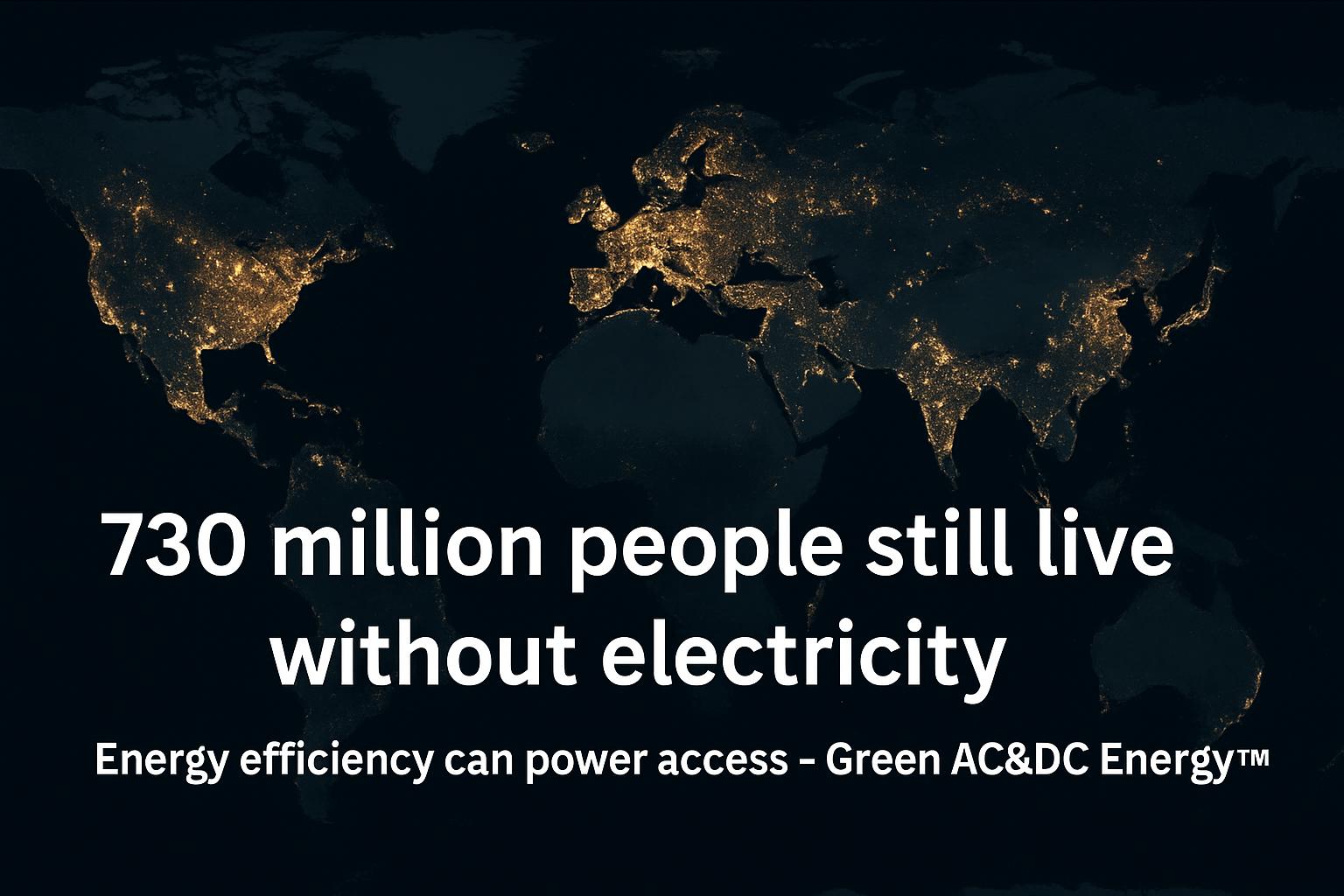
The International Energy Agency (IEA) warns in its latest assessment that around 730 million people worldwide still live without access to electricity.
Despite growth in renewable energy, progress on electrification has slowed, while power grids are becoming more strained and vulnerable. Sub-Saharan Africa is the most affected region, where energy poverty significantly hampers economic and social development.
The International Energy Agency (IEA) warns that global progress on access to electricity has stalled. According to the latest data, there were still around 730 million people in 2024 living without access to electricity, representing only a very small decline compared with previous years. This marks one of the slowest improvements in recent decades.
In its analysis, the IEA underlines that the advances achieved in previous years have largely stagnated in the aftermath of the Covid-19 pandemic and the recent global energy crisis. At the same time, pressure on power systems has increased: grids are becoming more heavily loaded and more vulnerable, especially in developing countries and in regions where demand for electricity is growing rapidly.
The largest number of people without electricity live in sub-Saharan Africa, where rapid population growth often cancels out the effects of new grid connections. In many countries, electricity prices have risen more quickly than household incomes, meaning that many families simply cannot afford electricity even when the grid is physically nearby. This creates a vicious circle of energy poverty, which undermines economic development and restricts access to education, healthcare and basic services.
The IEA also stresses that around 2 billion people worldwide still rely on traditional, inefficient and polluting fuels for cooking, such as firewood, charcoal, coal and kerosene. These practices cause severe indoor air pollution and lead to millions of premature deaths each year due to respiratory and cardiovascular diseases.
Although some countries – such as India, Indonesia and China – have shown that ambitious programmes can quickly expand access to electricity, the IEA warns that the world as a whole remains off track to achieve Sustainable Development Goal 7 (SDG7): universal access to modern energy. The analysis therefore presents a scenario in which it would be possible to achieve universal access to electricity by 2035 and to clean cooking by 2040, provided that governments strengthen policies, scale up investments in grids and distributed renewable energy, and target support to the most vulnerable households.
Global efficiency initiatives such as the Green AC&DC Energy™ concept show that it is technically possible to free up large amounts of electricity by reducing waste in homes, services and industry. If similar efficiency gains were scaled across major energy-consuming regions and a meaningful share of the resulting savings and avoided investments were directed into targeted electrification programmes in Africa and Asia, the freed electricity alone could be sufficient to cover at least the basic modern energy needs of the 730 million people who still live without power today. In this sense, energy efficiency is not only a climate and cost‑saving measure, but also a potential driver of global energy access and social justice.
Relevance to Green AC&DC Energy™
📎 Sources:
IEA (2025), Access to electricity stagnates, leaving globally 730 million in the dark.
Commentary, International Energy Agency, Paris, 9 October 2025.
IEA (2025), World Energy Outlook 2025. International Energy Agency, Paris.