
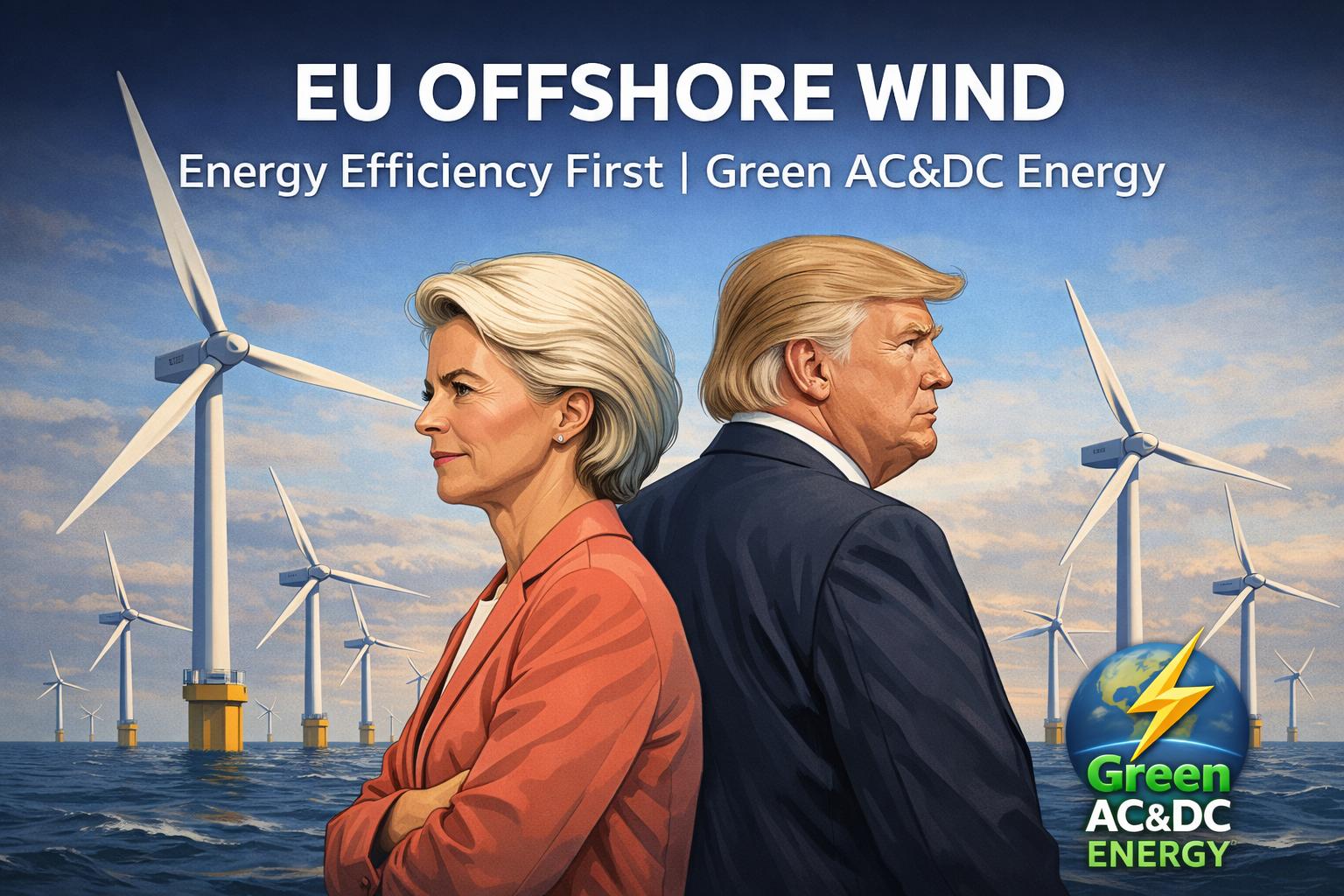
January 23, 2026 – EU / Hamburg. Reuters reports that nine European countries are preparing to reaffirm and accelerate offshore wind expansion, aiming for 300 GW by 2050, including 100 GW via joint cross-border projects. Green AC&DC Energy™ highlights the missing counterpart: Energy Efficiency First – because the cheapest capacity is the capacity you don’t need to build.
According to Reuters, countries including Germany, the UK, Denmark, the Netherlands and others are set to strengthen cooperation on major North Sea offshore wind projects, and to increase financial support. Reuters notes tools such as contracts for difference (CfD) and possible EU budget guarantees to improve revenue stability for projects. Reuters also points out recent headwinds for the sector: higher capital and component costs, and failed offshore wind auctions in parts of the North Sea.
Why this matters now
Reuters also cites a major EU power milestone: in 2025, wind and solar generated more electricity than fossil fuels in the EU for the first time (Ember data, as reported by Reuters). That shift makes the next phase of the transition more system-sensitive: the balance between new generation, grid/storages, and demand-side reduction becomes decisive.
The European Commission frames Energy Efficiency First as a guiding principle for policy and investment decisions: when efficiency is more cost-effective, it should be prioritised because it lowers system costs and reduces the need for new supply and infrastructure. Green AC&DC Energy™ position Green AC&DC Energy™ is built on one simple rule:
“The cheapest “new GW” is a saved GW.”
If Europe scales measurable efficiency (baseline measurement → intervention → standardised “before/after” proof in kWh, €/year, CO₂) across hotels, retail chains, industry and households, it can reduce how much new capacity must be built, how fast grids must be expanded, and how much public support is needed – while improving resilience.
What comes next (ground pilot logic)
The 2026 rollout logic is practical and repeatable:
1. Baseline measurement (real consumption reality)
2. Intervention
3. Standardised reporting (kWh / €/year / CO₂)
4. Replication across sites as a pilot network
Call for cooperation
Green AC&DC Energy™ invites:
– ESCO partners (implementation & scaling models)
– Hotels / large consumers (pilot sites & measurable optimisation)
– Universities / research groups (independent validation and methodology review)