
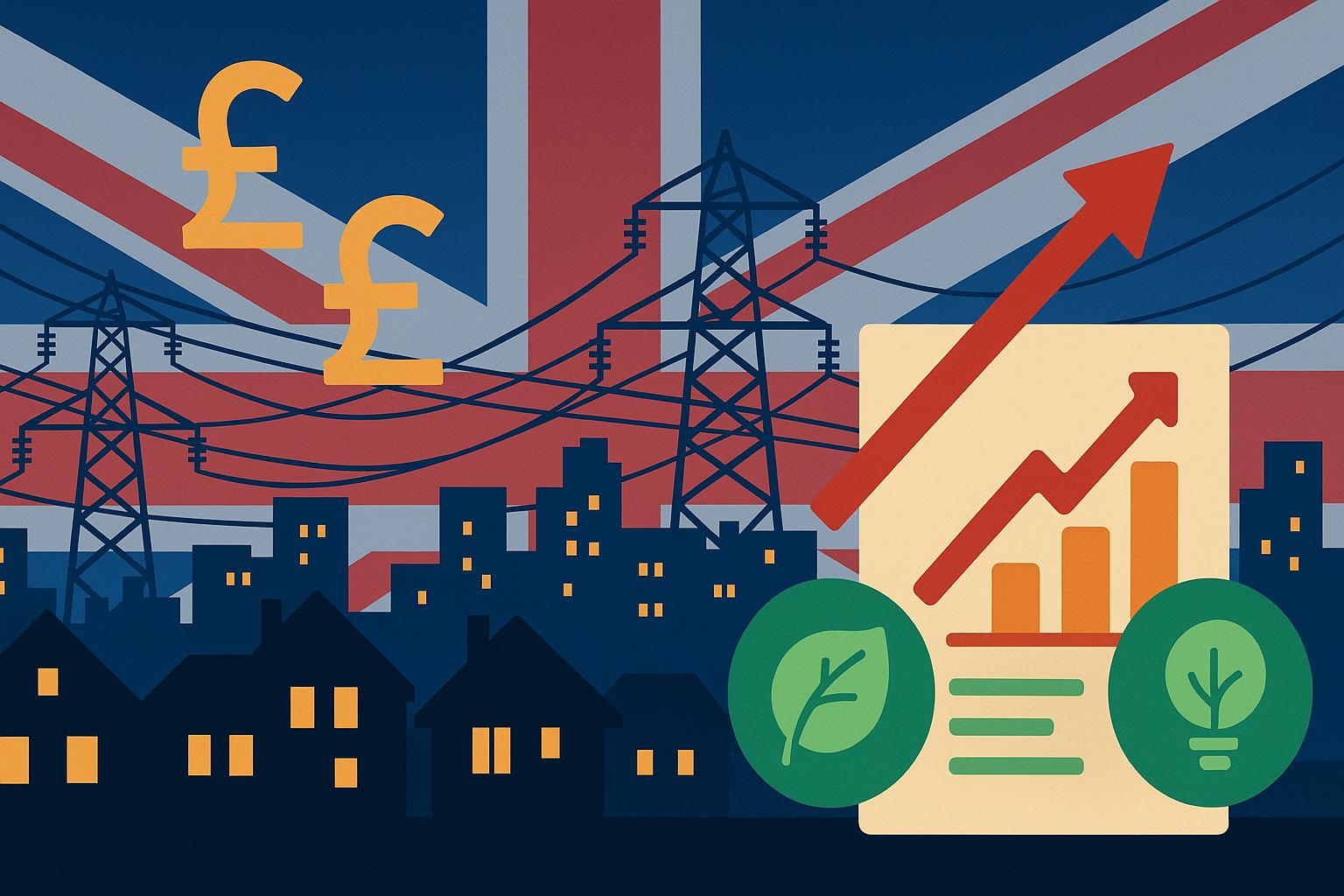
In the United Kingdom, a crucial battle is underway over who pays for the clean energy transition. The answer from the energy regulator Ofgem is clear: households will pay through higher bills.
Ofgem has approved around £28 billion of new investment into Britain’s gas and electricity networks over the next few years – as part of a wider programme that could reach £90 billion by 2031. These costs will be recovered through network charges on consumer bills.
By 2030–2031, the average household is expected to pay around £108 more per year in network charges compared with today, with some media estimates putting the impact closer to £116 per year by 2030. Much of the promised reduction in bills is therefore being eaten up by new grid levies. This has triggered a political storm, because the Labour government promised to cut energy bills – not raise them.
“Your bill is higher because of new cables you can’t see and don’t understand.”
That is not an easy message to sell.
1. What exactly is happening in the UK?
Key facts: Ofgem has signed off roughly:
- £17.8 billion for gas networks
- £10.3 billion for high-voltage electricity transmission
Network charges on bills are forecast to rise from about £222 per year to around
£330–338 per year by 2030–2031.
At the same time, the government has promised a £150 annual discount for households –
but new grid levies of roughly £108–116 per year wipe out most of that benefit.
This is why newspapers like The Sun and The Times argue that new network charges will
“wipe out” Rachel Reeves’s energy bill cut, turning a good-news story into a political headache.
2. Why invest so much in the grid?
On the technical side, Ofgem and the government argue that this spending is essential:
- The UK is rapidly building wind and solar capacity.
- It wants millions of electric vehicles and heat pumps.
- It needs to reduce dependence on imported gas and volatile global prices.
Without major grid upgrades:
- bottlenecks appear in the network,
- the system has to pay wind farms to switch off when lines are full,
- the risk of outages and extreme price spikes increases.
Ofgem says the £28 billion (rising towards £90 billion) will:
- improve security and resilience,
- allow more clean power onto the grid,
- and avoid even higher costs in the long run (by reducing “constraint payments” and over-reliance on gas).
Even so, the regulator admits that after all savings are counted, there will still be a net increase of around £30 per year on the average bill by 2031. The technical logic may be sound – but it leaves a political and social gap: people see higher bills now, while the benefits are diffuse, delayed and hard to see.
3. The missing piece: inefficient devices on the demand side
This is where the story connects directly to your world and to Green AC&DC Energy™. Right now, the UK strategy looks like this:
First, massively expand the grid – then deal with demand later.
That approach has three big problems:
1. Everyone pays, even if they don’t overload the network. Households and small businesses get higher bills regardless of how efficient they already are.
2. The biggest problem – inefficient devices inside buildings – remains largely untouched. Old minibars, fridges, freezers, display cabinets, ovens and HVAC systems keep wasting electricity every hour.
3. The system misses the chance to treat saved kilowatt-hours as a “first fuel”. Energy efficiency – especially measured under real conditions – is not treated as a resource as real as a new wind farm.
The result: we build more and more steel and cables to feed inefficient demand that could have been reduced at a fraction of the cost.
4. The ΔE* alternative: savings first, then steel and cables
Imagine the UK (or any EU country) adopted a ΔE*-based strategy, the core idea behind Green AC&DC Energy™:
- E₀ – energy use before the change (old minibar, old freezer, old AC unit…)
- E₁ – energy use after replacement or optimisation
- ΔE* – the measured difference in kWh, €/year and t CO₂/year, on the real site, not in a lab
Instead of spending everything on the grid first, governments and regulators could:
1. Launch a national ΔE* programme
- Replace the worst-performing appliances in hotels, retail chains and households.
- Each intervention is documented with a clear ΔE*: – kWh saved per year – money saved per year – CO₂ saved per year.
2. Use savings to relieve the grid
- Lower peak demand = less stress on cables and transformers.
- Fewer expensive “constraint payments” to wind farms.
- Some planned grid projects could be delayed, downsized or avoided.
3. Share the benefits more fairly
- Part of the “grid budget” goes into visible, concrete savings for end users.
- People see new, efficient equipment and smaller consumption on their bill – not just a mysterious new charge for “networks”.
This is exactly the philosophy of Green AC&DC Energy™:
We care about real-life performance, not just the numbers printed on labels.
5. What can the EU (and Slovenia) learn from the UK case?
The UK grid decision is a strong warning for the rest of Europe:
- If we only invest in networks, household bills will almost always rise in the short and medium term.
- If we ignore real-world efficiency in buildings, we are over-designing the grid for demand that should not exist.
A smarter strategy would require that every big grid plan has a “ΔE twin”:
1. For every major grid package, launch standardised ΔE* pilots in:
- hotels,
- supermarkets and food chains,
- apartment buildings,
- small industry.
2. Treat saved kilowatt-hours (ΔE) as an official resource in energy planning – just like new wind farms or solar parks.
3. Split public money between:
- grid reinforcement, and
- transparent, replicable ΔE* projects with public reference data (like a Metropol hotel pilot, retail pilots, etc.).
Then a minister could say to citizens:
“Your bill is higher because of new cables you can’t see and don’t understand.”
6. Conclusion: without ΔE*, every grid billion ends up on the bill
The British case shows how a technically sensible investment (a stronger grid for renewables and electrification) can become a political and social problem when demand-side efficiency is not integrated from the start. Without a framework like Green AC&DC Energy™ and ΔE*:
- demand in buildings stays artificially high,
- grid investments must be larger and faster,
- and every extra billion approved by regulators eventually lands on household bills.
With ΔE*:
- we quantify real, on-site savings in kWh, €/year and t CO₂/year,
- we connect big-picture planning with small, concrete device choices,
- and we create a bridge between network investment and visible benefits for hotels, retailers and families.
The lesson is simple:
If we don’t measure and value ΔE, the grid will always eat the promise of cheaper energy.
Measure and achieve ΔE on the demand side first – then expand the grid only as much as still needed.