Same Minibar. Same Brand. Same Size. Nearly 3× More Energy. A Hidden Efficiency Gap in Hotels.
By Lirim Muharemi
Introduction
In a time of energy uncertainty and increasing pressure to reduce CO₂ emissions, a small device found in millions of hotel rooms worldwide may be quietly driving unnecessary energy consumption: the minibar.
This is not a theoretical assumption.
It is based on on-site inspection, direct observation, and documented product energy labels.
What Was Found (Field Evidence)
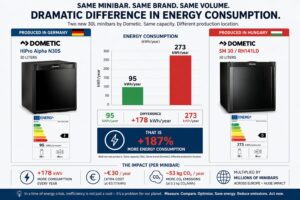
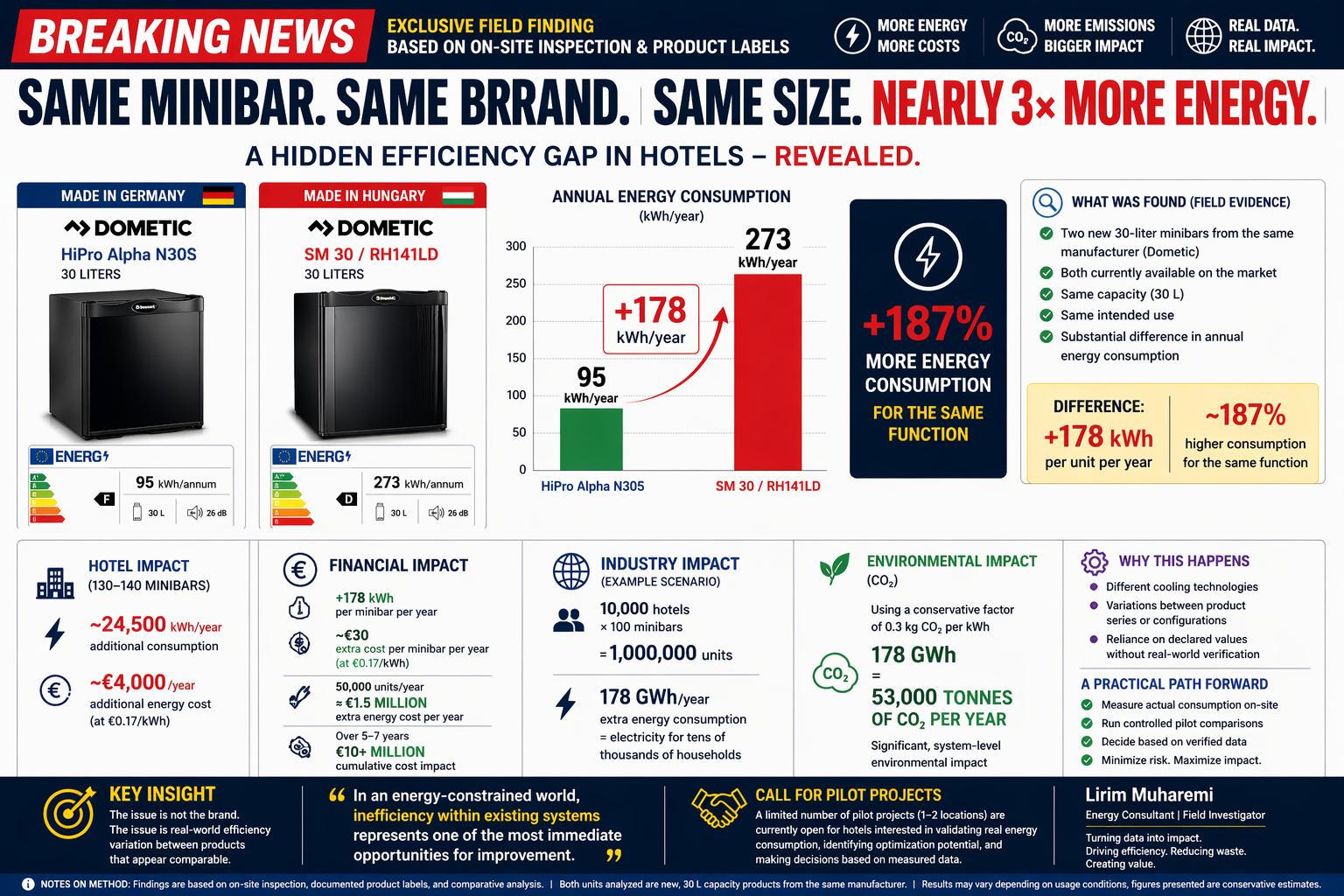
Two new 30-liter minibars from the same manufacturer (Dometic), both currently available on the market, show a substantial difference in annual energy consumption:
Minibar A (30 L): 95 kWh/year
Minibar B (30 L): 273 kWh/year
Difference: +178 kWh per unit per year
~187% higher consumption for the same function
This is not a comparison between older and newer equipment.
Both units:
are new products
have the same capacity (30 L)
serve the same purpose
What This Means in Practice
For a hotel with approximately 130–140 minibars:
~24,500 kWh/year additional consumption
~€4,000/year (at €0.17/kWh) – conservative estimate
This estimate does not include:
– increased load on HVAC systems
– potential differences in reliability and maintenance
– real-world operational inefficiencies
The actual impact is likely higher.
Financial Impact
The difference in energy consumption is not only a technical issue — it has a direct financial consequence.
178 kWh per minibar per year
Average electricity price: €0.17/kWh
~€30 additional cost per minibar per year
Hotel-Level Impact
~€4,000 per year per hotel (130–140 units)
Industry-Level Illustration
If scaled conservatively:
50,000 units/year
≈ €1.5 million/year in additional energy costs
Lifecycle Perspective
Over a typical lifespan of 5–7 years:
€10+ million cumulative cost impact
Why This Matters Beyond One Hotel
When scaled across the hospitality sector:
10,000 hotels × 100 minibars = 1,000,000 units
If a portion of these operate at higher consumption levels:
1,000,000 × 178 kWh = 178 GWh/year
This is equivalent to the annual electricity consumption of tens of thousands of households.
CO₂ Impact
Using a conservative factor of 0.3 kg CO₂ per kWh:
178 GWh ≈ 53,000 tonnes of CO₂ per year
This represents a significant, system-level environmental impact from a single equipment category.
Key Insight
The issue is not the brand.
The issue is real-world efficiency variation between products that appear comparable.
In practice, procurement decisions are often based on:
– brand
– size
– general specifications
However, actual energy performance can vary significantly.
Why This Happens
Differences may arise from:
– different cooling technologies
– variations between product series or configurations
– reliance on declared values without real-world verification
A Practical Path Forward
Rather than replacing equipment without analysis:
– conduct on-site energy measurements
– perform controlled pilot comparisons
– make decisions based on verified performance data
This approach minimizes risk and enables data-driven optimization.
Conclusion
In an energy-constrained world, inefficiency within existing systems represents one of the most immediate opportunities for improvement.
The minibar may be a small device – but at scale, it represents a measurable opportunity for both cost reduction and emissions reduction.
Call for Pilot Projects
A limited number of pilot projects (1–2 locations) are currently open for hotels interested in:
– validating real energy consumption
– identifying optimization potential
– making decisions based on measured data
Notes on Method
– Findings are based on on-site inspection, documented product labels, and comparative analysis
– Both units analyzed are new, 30 L capacity products from the same manufacturer
– Results may vary depending on usage conditions; figures presented are conservative estimates