
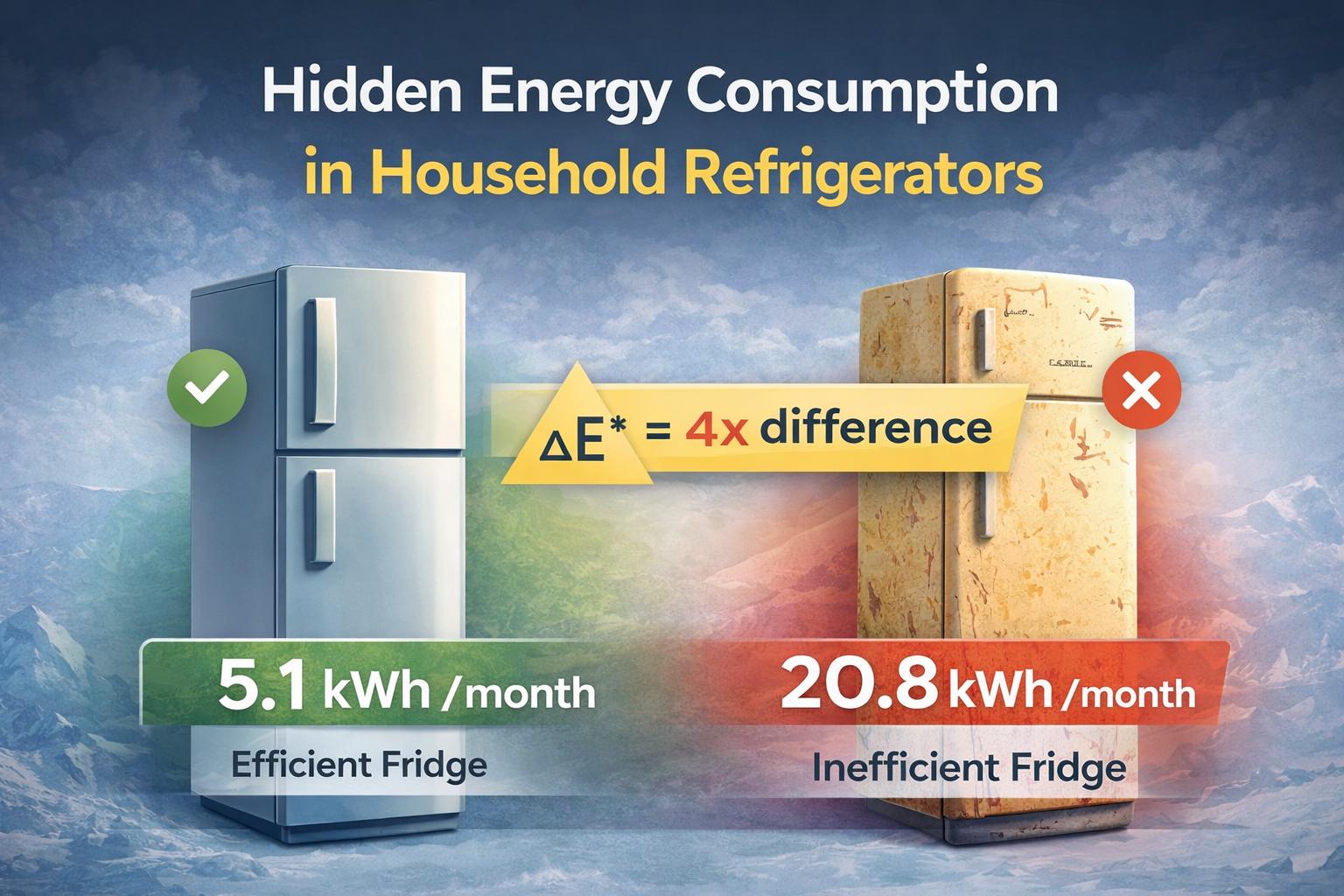
Real Monitoring Reveals Up to Fourfold Difference in Electricity Use
March 2026
Electricity consumption in households is often influenced by devices that operate continuously in the background. Among these, refrigerators are one of the most important appliances, as they run 24 hours per day throughout the entire year. Because of this constant operation, even relatively small inefficiencies in refrigerator performance can accumulate into substantial energy losses over time.
Recent real-world monitoring conducted as part of the Green AC&DC Energy™ initiative highlights how significant these differences can be. Using a smart energy monitoring system connected to household appliances, electricity consumption was measured over a monitoring period of 348.5 hours. The results reveal a striking contrast between two refrigerators operating under similar conditions.
Real Measurement Results
The monitoring system recorded the following electricity consumption values:
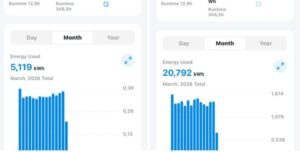
Despite operating under comparable usage conditions and runtime periods, the second refrigerator consumed approximately four times more electricity than the first.
This result clearly demonstrates that not all appliances with similar functions perform equally in terms of energy efficiency.
ΔE* Energy Difference
The difference between the two measured refrigerators can be expressed using the ΔE* indicator, which represents the difference in energy consumption between two comparable systems.
ΔE* = 20.792 kWh – 5.119 kWh
ΔE = 15.673 kWh per month*
Converted to an annual basis:
188 kWh per year per refrigerator
Assuming an average electricity price of 0.17 € per kWh, this difference corresponds to approximately:
32 € additional cost per year per appliance
While this amount may appear relatively small at the level of a single household appliance, the impact becomes much more significant when multiplied across larger populations.
Household Reality in Europe
Across Europe, many households still use refrigerators that are significantly older than current energy-efficient models. Appliances can remain in service for 10 to 20 years or more, especially when they continue to function reliably.
As a result, a large proportion of households still operate refrigerators with outdated compressors, less efficient insulation systems, or older cooling technologies. Various studies and appliance replacement programs suggest that up to 70–80% of households may still rely on refrigerators that consume significantly more electricity than modern optimized models.
These appliances often continue running silently in the background, making their true energy consumption largely invisible to consumers.
National Energy Impact
When inefficient appliances are present in a large share of households, their cumulative impact on national energy systems becomes substantial.
Consider the following simplified scenario:
If 100,000 households operate refrigerators with an excess consumption of 188 kWh per year, the total additional electricity demand would be:
18.8 GWh per year
This amount of electricity is equivalent to the annual consumption of thousands of households.
If scaled further to 1 million households, the additional consumption could exceed:
188 GWh per year
Such hidden energy losses represent a significant burden not only for households but also for electricity infrastructure and energy generation systems.
Why Real Monitoring Matters
One of the key challenges in improving energy efficiency is that many inefficiencies remain hidden. Appliance labels and manufacturer specifications often represent laboratory conditions, which may not accurately reflect real-world operation.
For this reason, the Green AC&DC Energy™ initiative focuses on real monitoring of electricity consumption using smart measurement devices. By collecting real-world data from households, hospitality facilities, and other sectors, it becomes possible to identify inefficient equipment and quantify the exact scale of potential energy savings.
This approach allows energy optimization strategies to be based on measured evidence rather than theoretical estimates.
Small Differences, Large System Impact
The comparison between two refrigerators clearly demonstrates how relatively small differences in device efficiency can accumulate into large energy losses when multiplied across millions of appliances.
Household refrigerators operate continuously and therefore represent an important opportunity for improving energy efficiency. Even modest improvements in appliance performance can translate into large reductions in electricity demand when applied at scale.
Reducing hidden inefficiencies in everyday appliances is one of the most effective ways to achieve long-term energy savings without reducing comfort or functionality for households.
Conclusion
This real-world measurement confirms a fundamental principle of energy efficiency:
“The cheapest and cleanest energy is the energy that is never consumed.
By identifying and addressing hidden inefficiencies in everyday household appliances, significant energy savings can be achieved at both household and national levels.
Real monitoring data will continue to play an essential role in uncovering these opportunities and supporting the transition toward a more efficient and sustainable energy system.